Contractor Website Redesign: Red Flags, Costs, and When It’s Time to Rebuild
A contractor website does not need to win design awards. It needs to make the phone ring, bring in quote requests, and give homeowners enough confidence to take the next step. That sounds obvious, but plenty of contractors end up stuck with websites that look decent at a glance and quietly underperform every week.
I have seen this happen with remodelers, coating companies, remediation crews, flooring installers, and niche trades that rely heavily on local trust. The owner knows the site feels old. The office manager says people still call. The marketing person points to traffic reports. Meanwhile, leads are weaker than they should be, mobile visitors bounce, and prospects who were ready to hire move on to a competitor with a cleaner, faster, easier site.
A contractor website redesign should not start with colors, fonts, or a mood board. It should start with a harder question: is the site helping customers do what they came to do? If the answer is no, then you may not need a touch-up. You may need a rebuild.
The real job of a contractor website
Most home-service sites are judged too superficially. Owners ask whether the site looks modern. Friends comment on the logo size. A spouse says the homepage feels busy. Those opinions are not worthless, but they are not the standard that matters.
The standard is whether a customer can land on the site, understand what you do, trust that you do it well, and contact you without friction. A strong site helps people answer basic questions quickly. Do you serve my area? Do you handle my type of project? Do you look legitimate? Can I call, text, or request an estimate without hunting around?
That matters whether you need home remodeling website design, mold remediation website design, flooring contractor website design, or something more specialized like pool screen enclosure website design or dock builder website design. Different trades have different sales cycles, but the customer’s first digital impression follows the same logic. Confusion kills momentum. Friction kills conversion.
Google’s guidance for business websites gets to the heart of it without overcomplicating things. Keep content current, make the site mobile-friendly, and prominently show contact information. Those are simple principles, but they expose a lot of weak contractor sites fast.
The red flags that usually mean your website is costing you work
Some website problems are cosmetic. Others are expensive. The expensive ones are the issues that create doubt or slow people down at the exact moment they are deciding whether to reach out.
Here are the signs I pay attention to first:
- Your site is difficult to use on a phone.
- Contact information is hard to find or inconsistent.
- Service pages are thin, outdated, or too generic.
- The site looks neglected, with old announcements, stale photos, or broken elements.
- Visitors cannot quickly tell what you do, where you work, or how to contact you.
A bad mobile experience is one of the clearest warning signs. Contractors often review their own site on a desktop in the office, but most prospects do not. They are on a couch at night, in the driveway between meetings, or comparing companies on their phone while talking to a spouse. If buttons are tiny, forms are clunky, or the page layout feels cramped, many will leave without a second thought.
Hard-to-find contact details are another trust killer. If the phone number is missing from key pages, if there is no obvious way to request a quote, or if users need multiple clicks to find your service area, your site is making prospects work too hard. The problem is not just inconvenience. It also creates a subtle sense that the business may be disorganized.
Outdated information does real damage. A homepage that promotes a special from two years ago, a team page with people who no longer work there, or a service description that no longer reflects your actual offering makes visitors question everything else. If the visible details are wrong, they start wondering what else is sloppy.
Then there is generic copy. This shows up a lot in specialized trades. An epoxy flooring website design should not sound interchangeable with a general handyman site. A concrete coating website design should make it clear what kinds of jobs you take, what surfaces you work on, and what kind of customer is the right fit. The same is true for mold remediation website design, where trust and clarity carry even more weight because the customer is usually stressed and wants certainty.
Redesign or rebuild? There is a difference
This is where many contractors waste money. They ask for a redesign when what they really need is a new foundation. Changing the paint on a weak structure rarely fixes the underlying business problem.
A redesign usually means refreshing the look and reorganizing what is already there. That can work if your content is solid, your pages are structurally sound, and the main issue is visual age or minor usability friction.
A rebuild is different. A rebuild is necessary when the site is fundamentally wrong for the way your company sells today. Maybe your services changed. Maybe your market got more competitive. Maybe the site was built as a cheap brochure years ago and was never designed to support lead generation properly. Maybe updates are so cumbersome that nothing stays current.
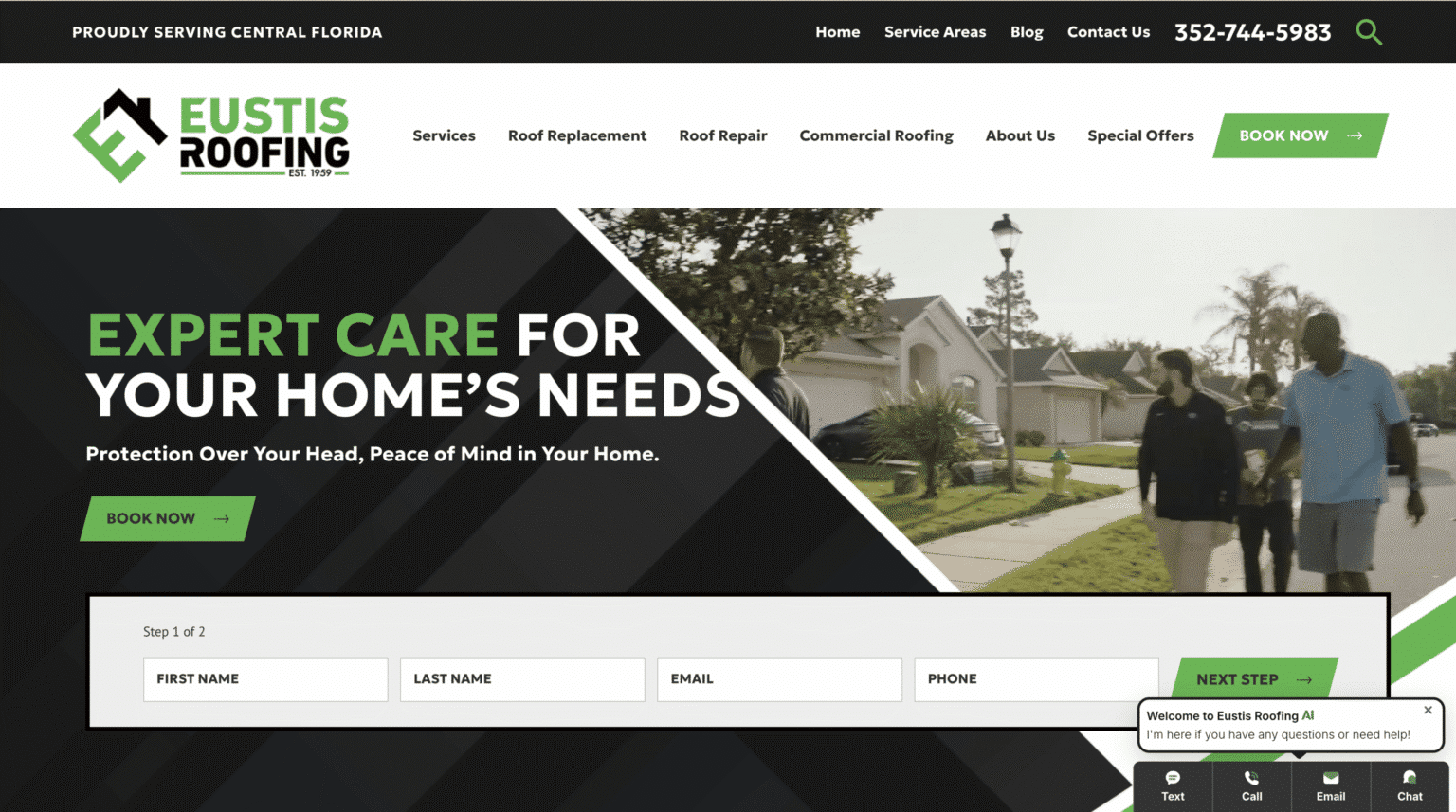
I usually see rebuilds make more sense in three situations. First, when the site no longer reflects the actual business. A remodeling company that now focuses on higher-value kitchen and bath work should not keep limping along with a generic handyman-style site. Second, when the technical setup is too restrictive or difficult to maintain. Third, when the site’s structure makes it hard for customers to complete obvious actions, like calling, submitting a form, or understanding specific services.
A contractor website redesign is worth pursuing only if you are clear on whether the problem is surface-level or foundational. Otherwise, you risk paying twice, once for cosmetic changes and again for the rebuild you postponed.
Specialty trades feel website problems faster
General contractors are not the only ones dealing with this. In fact, niche trades often feel the cost of a weak site more quickly because customers need reassurance that you understand their exact project.
Take pool screen enclosure website design. Homeowners usually want proof that you do this specific kind of work, not just vague exterior services. They want to see examples that feel relevant, not filler. A dock builder website design has a similar challenge. Visitors need to know you are experienced in that category, not just another contractor with a broad list of services.
The same pattern shows up with concrete coating website design and epoxy flooring website design. Customers compare visual results, but they are also evaluating professionalism. If the site feels dated or generic, the company can appear less established read more here than it really is. Flooring contractor website design has to overcome that same credibility gap, especially when prospects are looking at multiple local providers in one sitting.
For mold remediation website design, trust becomes even more urgent. These visitors are often anxious and looking for clear next steps. A cluttered or neglected site is especially damaging there because it sends the wrong emotional signal. They do not want style first. They want confidence, clarity, and a clean path to contact.
How much does a contractor website cost?
This is the question every owner asks, and the honest answer is that there is no single number. If you are wondering how much does a contractor website cost, the range depends on who builds it, how custom it needs to be, and how much support you want after launch.
DIY builders are usually the cheapest path. That can be perfectly reasonable for a small contractor who mainly needs a credible online presence, basic service pages, and lead capture. The trade-off is time, strategy, and polish. Saving cash upfront often means the owner is writing content, choosing templates, troubleshooting layout issues, and figuring out updates alone.
Freelancers generally sit in the low-thousands range and up, depending on scope. They can be a smart fit when you need design help, setup, and some custom touches, but not a large strategic engagement. A good web designer for contractors can clean up structure, improve presentation, and get a business out of the DIY stage without agency pricing.
Agencies typically make sense when the project involves broader strategy, more complex functionality, or deeper customization. Costs vary widely there and can climb quickly because you are not just paying for design. You are paying for process, coordination, strategy, and development resources.
Managed website options shift the model again. Instead of a large upfront build fee, many bundle design, hosting, security, backups, updates, and support into a monthly subscription. For some owners, that is easier to budget and easier to live with because the site is not abandoned after launch. It stays maintained. That can be attractive for a managed website for small business, especially when the company does not want to become its own webmaster.
One example is Scalable Websites, a Houston, Texas based managed website provider for contractors nationwide that offers professionally designed websites on a monthly subscription with hosting, security, unlimited updates, a dedicated project manager, and launches in days. That kind of model is not right for everyone, but it illustrates why “website cost” is not just a one-time design question. It is also an operations question.
The cheapest website is often the most expensive one to keep
Contractors tend to focus on build cost and ignore ownership friction. I understand why. Cash flow matters. But the wrong low-cost site can quietly drain more value than a more expensive option that actually gets maintained and used.
I have seen contractors save money on a quick build, then avoid making updates because every little change requires chasing a developer, logging into a confusing backend, or paying extra for minor edits. Six months later, the service pages are stale, the homepage still references an old promotion, and the gallery has not been touched. The site did not fail because it was ugly. It failed because it became a hassle.
That is why the best website builder for contractors is not one universal platform. It depends on the owner’s reality. If you genuinely enjoy handling content updates, can stay organized, and only need a simple web presence, a DIY builder may be enough. If you hate touching the site and know it will sit untouched for a year, then a managed or professionally supported setup is often the better financial choice, even if the sticker price looks higher.
A contractor who never updates a cheap site does not own a bargain. They own an aging liability.
When hiring a freelancer makes sense, and when it does not
A freelancer can be a strong middle path. If the job is straightforward and the business already has decent photos, service descriptions, and a clear offer, a freelancer may be all you need. This is often true for local companies that want a better-looking site with cleaner messaging and a simpler path to contact.
But there are limits. Some contractors need more than a designer. They need someone to shape the structure of the site around how customers actually buy. They need guidance on what pages matter, how to separate services, and how to make calls to action visible without turning the whole site into a shouting match.
That is where the difference between a generic designer and a web designer for contractors becomes obvious. Someone who understands home-service businesses knows that a quote request is not the only conversion. Sometimes a phone call matters more. Sometimes a service-area page matters because it answers a location question before the prospect bounces. Sometimes a niche trade needs distinct pages because the jobs are visually or operationally different.
If your business is specialized, the site should reflect that. A home remodeling website design should not be structured the same way as an epoxy flooring website design. The customer intent is different. The decision criteria are different. The hesitation points are different. Those differences should show up in the page flow, not just the wording.
What a strong rebuild usually fixes
A proper rebuild tends to solve deeper operational and conversion issues at once. The best ones are not flashy. They are clearer. They remove confusion and help the business present itself in a way that matches reality.
A strong rebuild usually improves five things:
- It clarifies the services you actually want to sell.
- It makes the site easier to use on mobile devices.
- It puts contact options where customers expect them.
- It updates trust signals, photos, and core messaging.
- It makes future updates easier so the site stays current.
That last point gets overlooked. Ease of maintenance matters because all websites drift. Services evolve. Team members change. Project photos improve. Markets shift. If the site cannot keep up without pain, it slowly stops representing the company well.
This is why managed hosting and support can matter more than many owners expect. Fully managed setups often handle hosting, security, backups, updates, and related maintenance behind the scenes. For contractors who do not want to think about server maintenance or platform upkeep, that convenience is not a luxury. It is the reason the site remains usable and current.
A website should be judged by conversions, not compliments
One of the biggest mindset shifts I push with contractors is this: stop evaluating the site like a piece of office decor. Judge it by whether it supports actions that matter.
A beautiful homepage means very little if users do not reach a contact form, call the office, or arrive on the page that confirms they completed the action you care about. Google’s framing here is practical. Think in terms of customer tasks and conversion pages, not vanity.
That changes the conversation. Instead of asking whether the homepage is modern enough, ask whether the right visitor can find the right service page and contact you in under a minute. Instead of debating whether the layout is exciting, ask whether the content answers common buying questions. Instead of worrying about whether a page feels sparse, ask whether it removes doubt.
I have watched contractor sites improve performance with changes that seemed almost boring on the surface. Stronger service-page headlines. Cleaner mobile buttons. Better contact placement. More current project images. Simpler navigation. Less clutter above the fold. These are not glamorous upgrades, but they work because they respect how people actually browse.
If you are trying to decide, use this standard
You probably need a rebuild, not a minor redesign, if your current website consistently fails at the basics. If it is outdated, weak on mobile, hard to update, confusing to navigate, or too generic to support the services you most want to sell, patching it usually delays the obvious.
You may be fine with a lighter redesign if the bones are good and the business has not changed much. Maybe the content still fits, the structure works, and the site mainly needs a cleaner visual refresh with better contact placement and fresher imagery. That is a very different project from replacing the system altogether.
The key is honesty. Contractors often know when a site has crossed the line from “not perfect” to “holding us back.” They just avoid the decision because web projects can feel vague, expensive, and time-consuming. Fair concern. But the cost of waiting is real too, especially when your competitors are making it easier for homeowners to trust them quickly.
A website does not have to do everything. It does have to do the important things well. It should accurately represent the business, work cleanly on a phone, make contact simple, and stay current without becoming a burden. If your current site cannot deliver that, the smartest move is not another round of cosmetic edits. It is a contractor website redesign, and in many cases, a full rebuild.
That is the moment when the question stops being “Can we get by with this a little longer?” and becomes “How much business are we willing to lose while we keep pretending this site is good enough?”