How Much Does a Contractor Website Cost? DIY Builders vs Freelancers vs Agencies vs Managed Website Subscriptions
Ask ten contractors what a website should cost and you will hear everything from “a couple hundred bucks” to “five figures, easy.” Both answers can be true, which is exactly why this topic causes so much confusion.
The real question is not just how much does a contractor website cost. It is what kind of website are you buying, how much time will you personally spend to get it live, and whether it will actually help you book work. A cheap site that never gets updated, loads poorly on a phone, or hides the phone number in a menu is expensive in the worst way. It costs less upfront and loses more revenue later.
I have seen this play out with home service businesses over and over. A remodeling company launches a site for almost nothing, then wonders why it never produces leads. A concrete coating contractor pays for a polished custom build, but nobody on the team has time to send updates or approve changes, so the portfolio sits stale for months. Another company signs up for a managed website for small business use, pays a predictable monthly fee, and finally gets a site that stays current without becoming another item on the owner’s Saturday to-do list.
There is no universal “right” website budget. The cost depends on design, features, functionality, and the ongoing work needed to keep the site useful. The smart way to evaluate price is to compare four paths side by side: DIY builders, freelancers, agencies, and managed website subscriptions.
What you are really paying for
A contractor website is not just a set of pages. It is a mix of design, content structure, mobile usability, lead capture, updates, security, hosting, and support. That matters because two websites can look similar at first glance and still have very different real costs.
One site might be built on a low-cost platform, with the owner writing the copy, choosing the photos, editing the pages, handling updates, and troubleshooting every issue alone. Another might include strategy, custom design decisions, someone organizing the navigation around customer tasks, someone managing hosting and backups, and ongoing support whenever a service page needs to change.
That is why pricing varies so widely. You are not buying “a website” in the abstract. You are deciding who does the work, who maintains it, and how much risk and effort stay on your plate.
For contractors, that distinction matters even more because your website has a practical job. It needs to reassure visitors fast, work on mobile, make contact details obvious, and help someone move from “I’m comparing companies” to “I’m ready to call.” If it fails at those basics, the lower price does not mean much.
The lowest upfront cost, DIY website builders
If your main goal is getting online quickly and cheaply, a DIY site builder is usually the least expensive path. That is why so many small contractors start here. It can be a perfectly reasonable move, especially if you mainly need a credible presence, contact information, service pages, and a simple lead form.
For some businesses, that is enough. A solo handyman, a new flooring installer, or a local service company testing a market does not always need a complex custom build on day one. If the site is mobile-friendly, current, and easy to navigate, it can do real work for the business.
The catch is that “DIY” rarely stays cheap if your time is valuable. Builders may be affordable, but they still require decisions. You have to pick the layout, write the copy, source the photos, build the pages, keep the content current, and make sure contact details stay visible. You also have to judge whether what you built actually feels trustworthy to a customer who has never heard of you.
That is where many contractor websites go sideways. Owners know their trade, not web structure. A service page for home remodeling website design needs a different message than one for mold remediation website design. A pool screen enclosure website design should not read like a generic roofing page. An epoxy flooring website design should quickly show project visuals and local relevance. A DIY builder can technically support those pages, but it cannot make the strategic decisions for you.
This is why the best website builder for contractors is not necessarily the cheapest builder. It is the one you can actually manage well enough to keep updated, organized, and useful to customers. If you are disciplined, comfortable editing content, and only need a basic web presence, DIY can be a smart starting point. If you already struggle to return callbacks before dinner, it often becomes a false economy.
Hiring a freelancer changes the equation
A freelancer sits in the middle ground. You are no longer doing everything yourself, but you are not buying a full agency process either. For many contractors, this is the first serious step up from DIY.
A good freelancer can handle setup, design, page creation, and custom touches you probably would not execute well on your own. That alone can be worth the project cost. Many small businesses simply need a cleaner, more professional site than they would ever build themselves.
The price here typically moves into project fees rather than just monthly software costs. Exact numbers vary, but this is where budgets usually leave the “cheap builder” category and start climbing into the low thousands and beyond, depending on complexity. The spread is wide because freelancers vary wildly. Some mainly customize templates. Others https://servicesitejournal561.rivetgarden.com/posts/local-seo-for-home-service-businesses-how-accurate-service-areas-can-improve-lead-generation bring sharper design judgment, stronger copy structure, and better technical skill.
This route works best when your needs are clear and fairly contained. Maybe you need a flooring contractor website design that looks more polished, showcases completed projects, and gives customers a smooth path to request an estimate. Maybe your current site looks dated, has poor mobile usability, and buries your phone number, so you need a contractor website redesign without a large agency engagement.
The risk is inconsistency. Some freelancers are excellent. Some disappear mid-project. Some can build the site but do not offer reliable support after launch. Some are strong visually but weak on the practical side, like organizing service pages around what customers actually search for or making sure the contact path is obvious on mobile.
That does not make freelancers a bad choice. It means you should hire a web designer for contractors, or at least someone who understands local service businesses, not just a generalist with a portfolio full of unrelated industries. Contractors need websites built for speed, clarity, trust, and action. Pretty alone does not book estimates.
Agencies cost more because they solve broader problems
Agencies are usually the most expensive path, and that cost can be justified when the needs are bigger than basic design. If your company wants broader strategy, custom development, more involved functionality, or a more comprehensive approach to branding and digital growth, an agency can make sense.
This is where costs can move from the low thousands into much higher ranges. Again, there is no single fixed price because scope changes everything. A simple contractor site and a custom strategic build are not in the same category.
Agencies are often better suited to established companies with multiple service lines, larger teams, or more demanding marketing needs. A business that handles home remodeling, flooring, concrete coating, and commercial work across several service areas may need more planning and stronger information architecture than a simple starter site can provide. The same goes for specialty trades where the sales process benefits from carefully structured pages, such as dock builder website design or mold remediation website design, where trust and clarity matter immediately.
The advantage of an agency is not just prettier pages. It is the chance to get more deliberate thinking around positioning, user flow, and complex requirements. The downside is obvious. It costs more, often takes longer, and may be more than a smaller contractor truly needs.
I have seen small operators overspend here because they assumed the most expensive option must also be the most profitable. Not always. If your customers mainly want to verify you are legitimate, understand your services, view a few examples, and contact you fast, a large agency process may be more machinery than you need.
The subscription model, managed websites for contractors
Managed website subscriptions have become attractive for one simple reason: most contractors do not want to become part-time website managers.
This model usually bundles the recurring tasks that create headaches after launch, things like hosting, security, backups, updates, and support. That bundled approach changes the budgeting conversation. Instead of a large project fee followed by scattered maintenance costs and random tech problems, you pay a monthly amount for the site and the service around it.
For busy owners, this can be the most practical option. The site is professionally designed, the technical maintenance is handled, and changes do not depend on whether you can carve out two hours on a Sunday afternoon. That convenience is not cosmetic. It is often the difference between a website that stays current and one that slowly decays.
Google’s guidance for business websites is straightforward and useful here. Keep content current. Make the site mobile-friendly. Make contact information prominent. That sounds simple, but it only happens consistently when someone is responsible for it. Managed plans solve for responsibility.
This model is especially strong for contractors who need speed, predictability, and support more than they need a deeply custom process. A managed website for small business use can be a good fit if you want to launch quickly and avoid piecing together hosting, security, backups, and edits from different vendors.
One example is Scalable Websites, a Houston, Texas based managed website provider for contractors nationwide, offering professionally designed websites on a monthly subscription with hosting, security, unlimited updates, a dedicated project manager, and launches in days.
That sort of offer appeals to contractors who care less about “owning every technical detail” and more about getting a site live and keeping it useful.
A side-by-side look at the trade-offs
| Option | Typical cost pattern | Best fit | Main trade-off | | --- | --- | --- | --- | | DIY builder | Lowest upfront cost, ongoing platform fees | New or very budget-conscious contractors who can manage content themselves | Lowest cash outlay, highest personal time investment | | Freelancer | Project fee, often in the low thousands or higher depending on scope | Small businesses needing professional setup without full agency complexity | Quality and support can vary a lot | | Agency | Larger project fee, can go much higher based on strategy and functionality | Established companies with broader needs or complex builds | Highest cost and often longer process | | Managed subscription | Predictable monthly fee with bundled services | Contractors who want convenience, support, and fewer technical headaches | Ongoing monthly commitment instead of one-time project cost |
That table is the clean summary, but the decision usually becomes clearer when you ask a more practical question: who is going to keep this website useful six months from now?
A website rarely fails because of the launch. It fails because nobody updates the copy, removes outdated information, refreshes project photos, or fixes small issues before they become credibility problems.
When cheap is smart, and when cheap gets expensive
A lower-cost website is not automatically a bad decision. Sometimes it is exactly right.
If you are starting from zero, testing a new market, or simply need an online business card that looks respectable, a DIY or lower-cost freelancer route can be enough. A straightforward site with current information and a clear phone number beats no site at all.
But cheap gets expensive when the site hurts trust. Outdated announcements, stale pricing references, clumsy mobile layouts, confusing navigation, or missing contact details create friction fast. Customers do not study these issues analytically. They just leave.
That is why a contractor website redesign becomes necessary sooner than many owners expect. Not because the site looks old in some abstract sense, but because it no longer helps customers complete the actions that matter. If users cannot quickly find your services, see where you work, and contact you without hunting, the website is underperforming no matter what you paid for it.
This is especially true in visual and trust-driven trades. A concrete coating website design, epoxy flooring website design, or pool screen enclosure website design often needs fresh examples and obvious proof of active work. If the site feels neglected, prospects notice. The same goes for home remodeling website design, where homeowners often compare several companies and make quick judgments based on professionalism and ease of use.
The hidden cost most contractors ignore
The biggest hidden cost is owner time.
Many contractors compare website options as if dollars are the only input. They are not. Every hour you spend building pages, troubleshooting plugins, revising layouts, or chasing a missing update is an hour not spent estimating jobs, managing crews, or following up with prospects.
I have seen owners save money on paper and lose it in practice because the website project dragged on for months. They kept rewriting copy, changing service descriptions, and debating colors because nobody was steering the process. Meanwhile, the business still had an outdated site or no site at all.
That delay matters. A simple, live, current site usually outperforms the “perfect” site that never launches.
This is why convenience has real value. Managed services and strong freelancers are not charging only for design. They are charging for progress, support, and fewer bottlenecks. Agencies charge for a broader layer of thinking and execution. DIY saves cash but demands your labor. Once you look at it that way, the pricing starts to make more sense.
How to choose based on the business you run
The best choice depends less on what sounds impressive and more on how your company operates day to day.
Use this lens when deciding:
- If cash is tight and your needs are basic, DIY can work, provided you will actually keep the site updated and mobile-friendly.
- If you want a more professional look without a large strategic engagement, a freelancer may offer the best balance.
- If your business has more complexity, broader service lines, or custom requirements, an agency may earn its higher fee.
- If you want predictable costs, bundled support, and less technical burden, a managed website subscription is often the easiest operational fit.
- If your current site is outdated, hard to navigate, or weak on mobile, prioritize a contractor website redesign before chasing more traffic.
That last point matters. More traffic does not solve a weak website. It only sends more people to the same friction.
What makes a contractor website worth paying for
A website earns its keep when it helps a prospect complete an action you value. That could be calling, submitting a form, requesting an estimate, or reaching a thank-you page after contacting you. Good contractor websites are built around those moments.
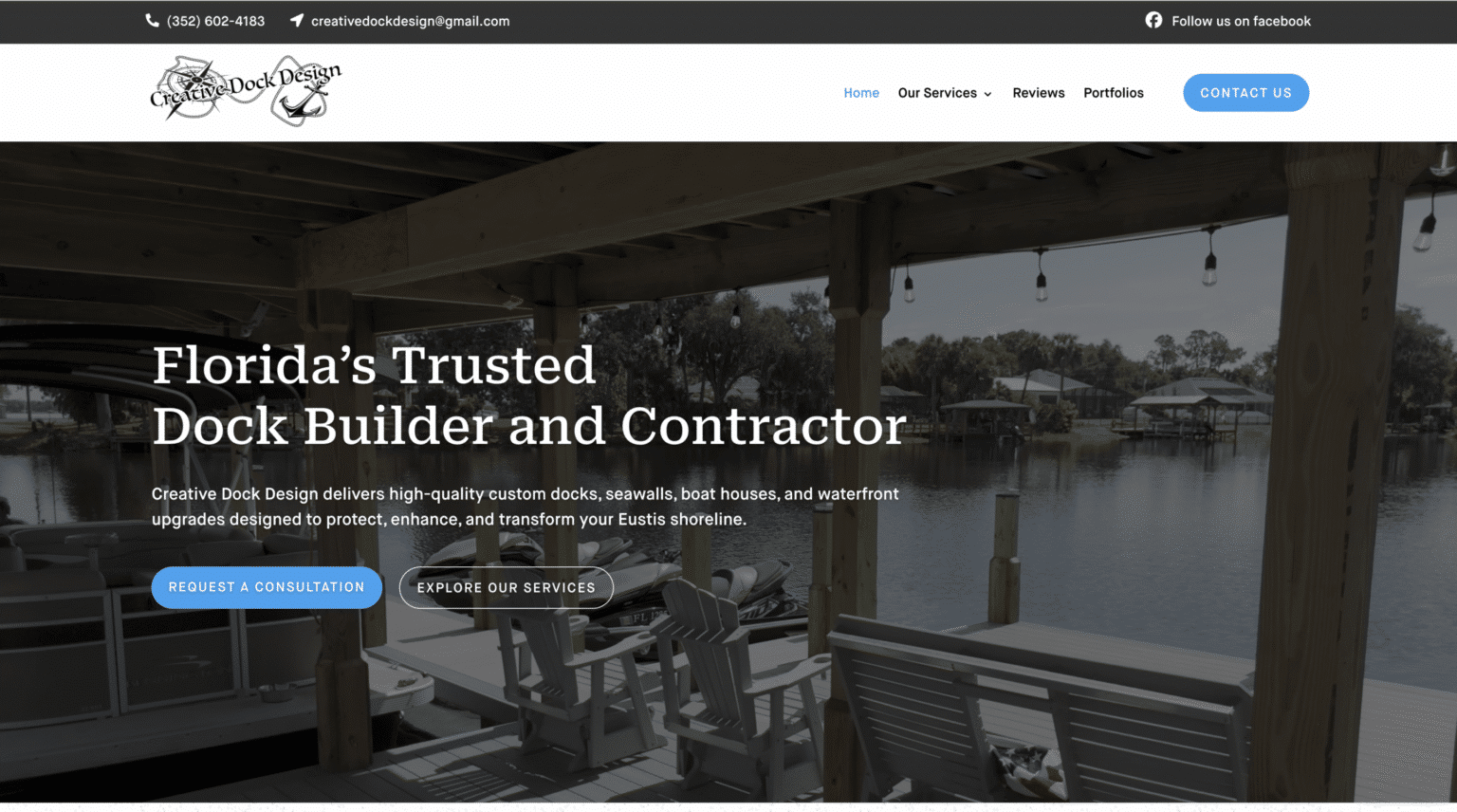
This is why judging a site by appearance alone is a mistake. A sharp design that confuses visitors is less valuable than a cleaner, simpler site that makes action obvious. Think like the customer. They want to know what you do, where you work, whether you seem trustworthy, and how to contact you. The faster your site answers those questions, the more useful it becomes.
That applies across specialties. A flooring contractor website design needs clarity around service types and easy contact. A mold remediation website design needs to feel credible and current. A dock builder website design should make the company’s work easy to understand. An epoxy flooring website design should highlight visuals and make quote requests simple. These are not radically different technical problems, but they do require decisions tailored to the service, not copied from a generic template.
The real answer to “how much does a contractor website cost?”
It costs anywhere from modest ongoing software fees to substantial project investments, depending on who builds it, how custom it needs to be, and who handles the ongoing work. That range is frustrating if you want a neat number, but it is the honest answer.
If you want the lowest upfront spend, DIY wins. If you want help without going all the way to a full agency, a freelancer may fit. If you need broader strategy or custom functionality, agencies justify higher fees. If you want convenience, support, and a predictable monthly expense, managed subscriptions are often the strongest value.
The best decision is rarely the cheapest or the most expensive. It is the option that matches your time, budget, and tolerance for ongoing website management. Contractors already manage crews, estimates, schedules, suppliers, and callbacks. For many, the smartest website investment is the one that removes work from their plate and keeps the site current enough to keep generating trust.
That is the benchmark worth using. Not “How little can I spend?” but “What am I paying to get, and will this website stay useful once the launch excitement wears off?” If you answer that honestly, the right budget usually becomes obvious.